
How We Built an AI-Powered Web Data Extraction Pipeline at Scale


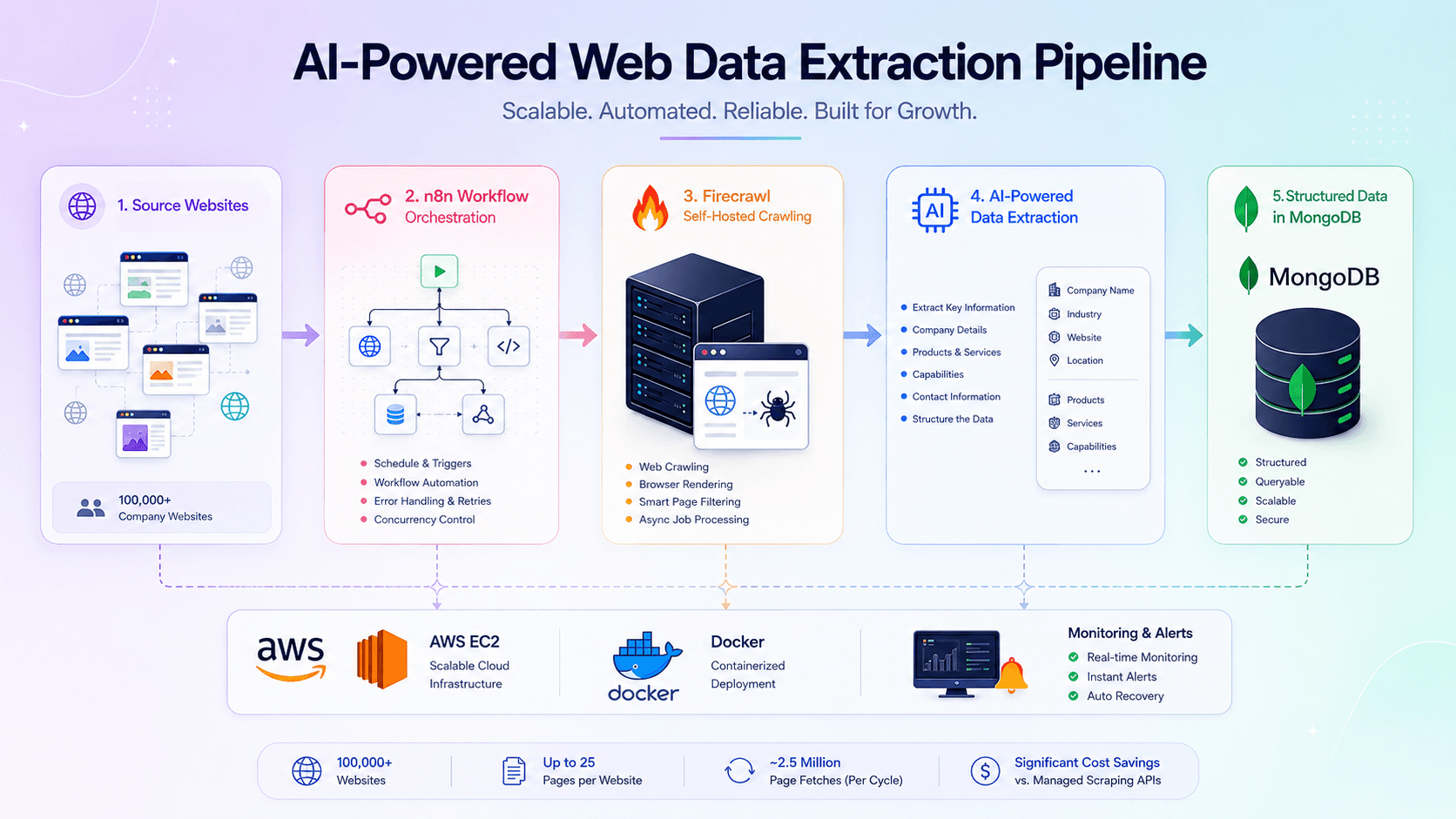
How We Built an AI-Powered Web Data Extraction Pipeline at Scale
Turning thousands of company websites into clean, structured database records sounds straightforward until you try to automate it at scale.
Every website is different. Some contain hundreds of pages. Some are built heavily with JavaScript. Others have limited navigation, inconsistent content, or important information buried across product and service pages.
The challenge was not simply to crawl these websites. It was to create a reliable pipeline that could identify useful content, extract the required information, structure it correctly, and continuously write it into a database without depending on manual research.
The Scale of the Challenge
The pipeline was designed to process:
- More than 100,000 company websites
- Up to 25 pages per website
- Approximately 2.5 million page fetches in a single pass
Researching this information manually would require years of dedicated effort.
Using a managed scraping API was technically possible, but processing this volume would cost several thousand dollars in credits for every complete pass. The same cost would return whenever the dataset needed to be refreshed.
We needed an approach that was scalable, reusable, cost-efficient, and fully under our control.
Building the Crawling Infrastructure
We deployed the complete open-source Firecrawl stack on self-hosted cloud infrastructure.
The setup includes:
- API services
- Headless browser rendering
- Job queues
- Message brokering
- Docker-based deployment
- Automated restart and recovery policies
Self-hosting gave us direct control over how websites were crawled and which pages were included.
Instead of collecting everything, the pipeline filters out low-value pages such as blogs, privacy policies, legal notices, careers pages, and login flows.
It prioritizes the information required to build a useful company record:
- Company information
- Products and services
- Contact details
- Business capabilities
- Relevant profile information
This reduces unnecessary crawling, improves extraction quality, and helps control infrastructure usage.
Orchestrating the Pipeline with n8n
Firecrawl handles the crawling, but n8n manages the complete workflow.
The automation reads source URLs from the database and submits crawl jobs based on the concurrency that the infrastructure can safely handle.
It then:
- Reads pending website records
- Creates crawl jobs
- Monitors asynchronous job progress
- Collects completed crawl results
- Sends the content for AI-powered extraction
- Converts unstructured content into a defined schema
- Validates and stores the structured records
- Updates the processing status
- Reports failures that require attention
The processing speed is deliberately matched to the available infrastructure.
Increasing concurrency without considering CPU, memory, browser load, and queue behaviour can make a pipeline less reliable rather than faster. The goal was sustainable throughput, not simply the highest possible request count.
Using AI to Structure the Data
Raw crawled content is not immediately useful.
Even after a webpage is converted into clean markdown, the information still needs to be understood, classified, and mapped into consistent database fields.
The AI extraction layer identifies relevant information and converts it into structured records that can be searched, filtered, and used by the application.
This creates a clear flow:
Company website → Clean content → AI extraction → Structured record → Database
The result is not just a collection of downloaded webpages. It is application-ready data.
Designing the Pipeline to Fail Loudly
One of the most important parts of the system is monitoring.
A pipeline that runs unattended must make problems visible immediately. Otherwise, a stalled queue or failed crawl can remain unnoticed for days and create significant gaps in the dataset.
The workflow monitors for:
- Failed crawl jobs
- Stalled processing queues
- Infrastructure interruptions
- Missing or incomplete results
- Data extraction errors
- Records requiring manual review
Real-time alerts notify the team when intervention is required.
Retries are also controlled carefully. They are designed to recover from temporary problems without repeatedly looping through failures that require a different response.
Right-Sizing the Infrastructure
The complete stack runs on deliberately sized AWS infrastructure using EC2, Docker, and Docker Compose.
Instead of over-provisioning for peak workloads, we tuned the number of concurrent jobs to what the hardware could reliably sustain.
The infrastructure is also operated on demand. Since this workload does not require continuous 24/7 processing, resources can be activated when a crawl or refresh cycle is required.
This keeps the operating cost significantly lower while maintaining control over performance and reliability.
The Outcome
The completed pipeline provides several important advantages.
Significant Cost Reduction
Processing the full dataset through managed scraping APIs would cost several thousand dollars for each pass. Self-hosting reduces this to a small fraction of that cost.
Reliable Unattended Processing
Automated restart policies, controlled retries, job monitoring, and alerts allow the workflow to operate for extended periods without constant supervision.
Reusable Infrastructure
The infrastructure can be used again whenever the dataset needs to be refreshed. The team does not need to repurchase the entire crawl volume through API credits.
Full Pipeline Ownership
We retain control over:
- Crawl scope
- Page filtering
- Processing speed
- Extraction rules
- Data structure
- Monitoring
- Infrastructure cost
- Future product changes
This makes it easier to evolve the pipeline as the application and data requirements change.
Technology Stack
- Firecrawl, self-hosted
- n8n
- AWS EC2
- MongoDB
- Docker and Docker Compose
- AI-powered structured data extraction
Final Thought
Web data extraction is often described as a scraping problem. At this scale, it is really an orchestration, infrastructure, and data-quality problem.
Crawling pages is only one part of the process.
The more difficult work is ensuring that millions of page fetches move through the system reliably, failures are handled properly, useful information is separated from noise, and the final records are structured enough to support a real product.
That is what turns collected web content into usable business data.
If you are working on a similar data extraction, automation, or AI pipeline, I would be happy to discuss the architecture and the lessons we learned.