How AI Platforms Improve Manufacturing & Healthcare Workflows


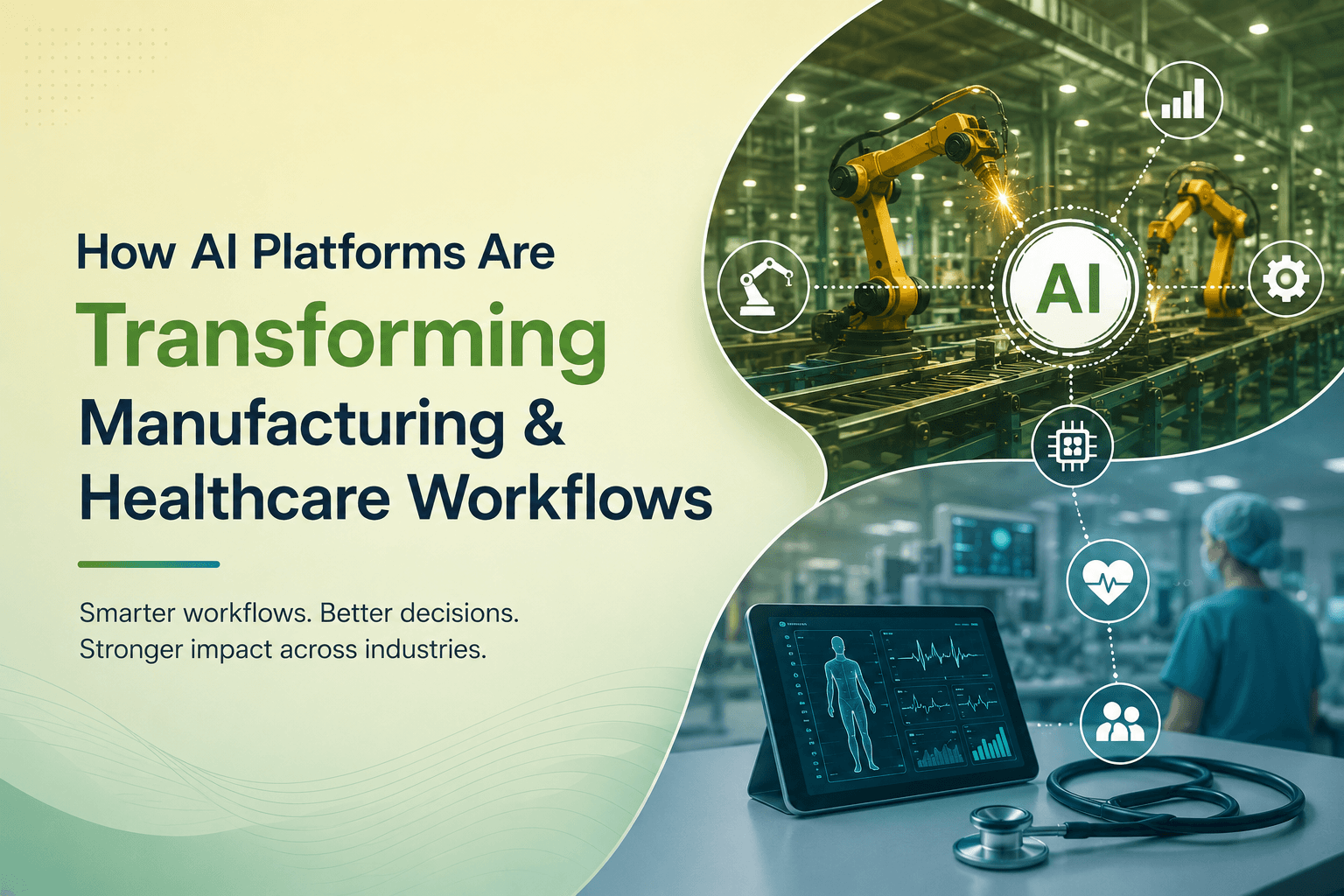
Businesses across manufacturing and healthcare industries are under constant pressure to improve operational efficiency, reduce manual work, and make faster decisions. However, many organizations still rely on disconnected systems, spreadsheets, emails, and repetitive manual processes to manage critical workflows.
This is where AI platforms are beginning to make a real impact.
Instead of functioning as standalone tools, modern AI platforms are helping businesses connect workflows, automate repetitive operations, improve visibility, and support better decision-making across departments.
The conversation around AI is often focused on futuristic concepts, but the real transformation is happening at the workflow level — where businesses are using AI to solve practical operational challenges.
AI in Manufacturing Workflows
Manufacturing businesses deal with multiple moving parts every day — procurement, inventory, production planning, supplier coordination, maintenance tracking, quality checks, documentation, and reporting.
Managing these workflows manually often creates delays, inefficiencies, and dependency on individuals or disconnected systems.
AI platforms are helping manufacturers streamline these operations in several ways.
- Predictive Maintenance
AI-powered systems can analyze machine behavior, sensor data, and operational patterns to identify early signs of equipment failure before downtime occurs. This helps reduce unplanned stoppages and improves production continuity.
- Supplier & Procurement Workflows
Manufacturers often spend significant time identifying suppliers, managing inquiries, comparing quotations, and tracking procurement communication.
AI platforms can assist by organizing procurement workflows, categorizing product requirements, identifying supplier patterns, and automating communication processes.
- Production & Workflow Visibility
Modern AI platforms also help manufacturing teams centralize production workflows and improve visibility across departments. Instead of relying on spreadsheets or fragmented updates, businesses can track operational activities through connected digital systems.
- Quality Monitoring & Documentation
Manufacturing processes generate large amounts of operational and compliance-related data. AI systems can help organize documents, monitor process consistency, identify anomalies, and simplify reporting workflows.
The goal is not to replace teams, but to reduce repetitive manual effort and help businesses operate with better speed, accuracy, and scalability.
AI in Healthcare Workflows
Healthcare organizations manage highly complex workflows involving patients, providers, appointments, reports, records, communication, and operational coordination.
In many cases, teams still depend on manual coordination between multiple systems and departments.
AI platforms are helping healthcare businesses improve operational efficiency while making workflows more connected and accessible.
- Patient & Provider Coordination
AI-powered systems can assist healthcare teams by organizing patient workflows, improving provider discovery, simplifying appointment coordination, and reducing manual communication overhead.
This becomes especially valuable in areas like medical tourism, multi-specialty healthcare networks, and distributed care systems.
- AI Assistants & Workflow Automation
Healthcare organizations are increasingly using AI assistants to support patient engagement, answer repetitive queries, guide users through processes, and improve operational responsiveness.
These systems help reduce administrative workload while improving accessibility for patients and internal teams.
- Centralized Information & Workflow Visibility
Healthcare workflows often involve multiple stakeholders and disconnected data sources. AI platforms can help centralize information, improve process visibility, and reduce dependency on manual tracking systems.
- Reporting & Operational Efficiency
AI systems can also support healthcare operations by organizing reports, extracting structured information from documents, improving internal coordination, and reducing repetitive administrative tasks.
Why Businesses Are Moving Towards AI Platforms
The adoption of AI platforms is growing because businesses are looking for more than just software applications. They want connected systems that improve decision-making, reduce operational friction, and scale with business growth.
Some of the major benefits include:
- Reduced manual effort
- Faster operational workflows
- Better visibility across departments
- Improved process standardization
- Centralized information management
- Smarter decision-making support
- Better scalability for growing operations
AI platforms are gradually becoming operational layers that sit across workflows instead of functioning as isolated tools.
Challenges Businesses Still Face
Despite the growing interest in AI, implementation is not always straightforward.
Many organizations still struggle with:
- Legacy systems
- Fragmented operational tools
- Unstructured data
- Integration challenges
- Process inconsistencies
- Adoption resistance across teams
This is why successful AI implementation requires more than simply adding AI features into existing systems. Businesses need well-structured workflows, clean operational processes, and scalable digital foundations.
Final Thoughts
AI platforms are not replacing businesses or operational teams overnight. Their real value lies in helping organizations simplify workflows, improve operational efficiency, and make systems more intelligent over time.
In both manufacturing and healthcare industries, businesses are increasingly adopting AI-driven workflows to reduce manual dependency, improve visibility, and create more scalable operational systems.
As organizations continue modernizing their internal processes, AI platforms will likely become a core part of how businesses manage operations, workflows, and decision-making in the future.