

When organizations decide to modernize a legacy monolithic system, the instinct is often to break everything into modules as quickly as possible. The assumption is simple: more services mean more agility. In reality, this “boil the ocean” approach creates chaos, technical risk, and delayed value.
The real challenge isn’t modularizing the system. It’s choosing what to modularize first.
Why Random Extraction Fails
Monoliths are deeply interconnected. Business logic, database access, integrations, and UI flows are tangled together through years of quick fixes and urgent releases. When teams start pulling pieces out without a strategy, they face cascading failures:
- Unexpected dependencies
- Broken workflows
- Integration regressions
- Increased testing overhead
Instead of reducing complexity, the system becomes harder to reason about.
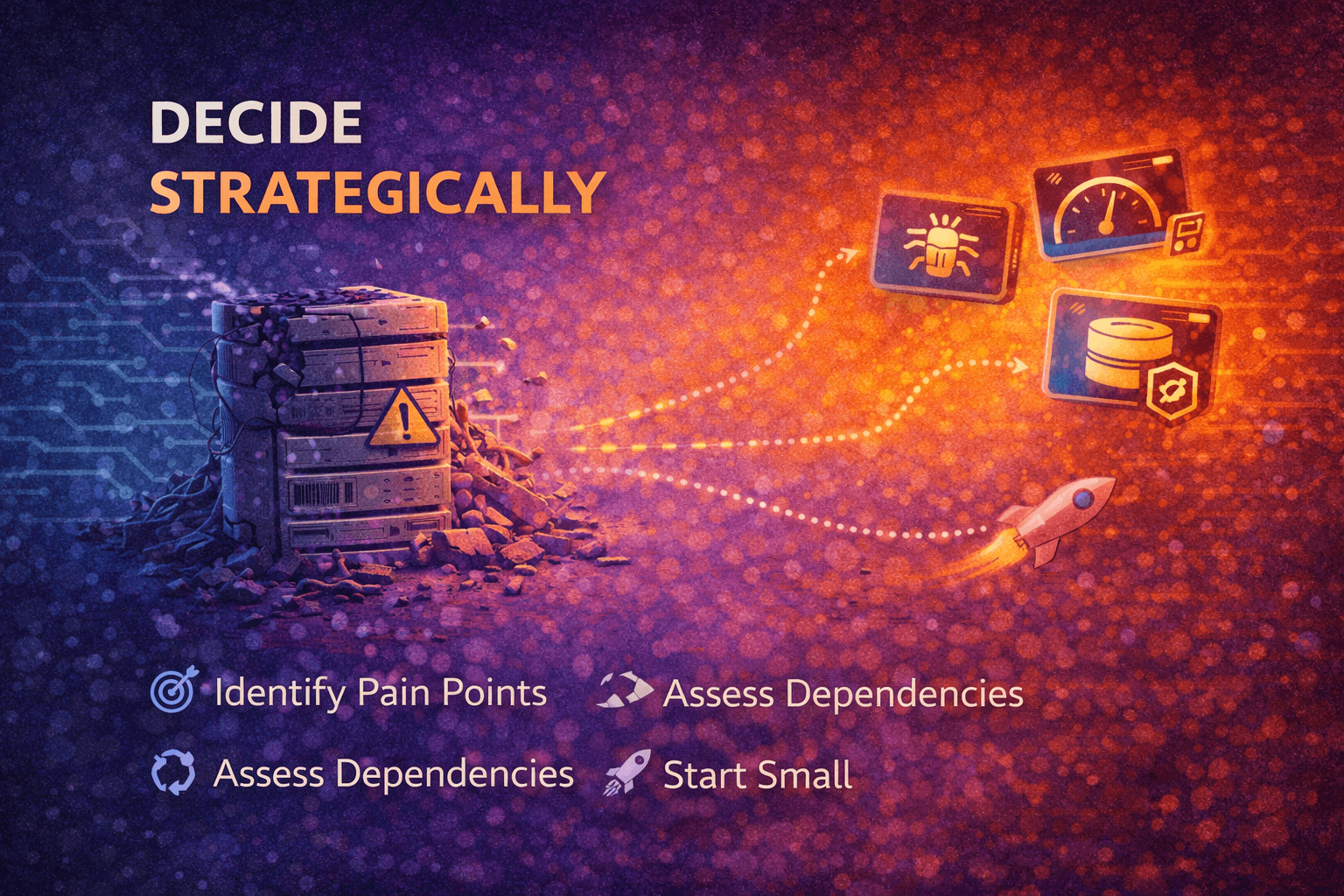
Step 1: Identify True Pain Points
The best candidates for extraction are not necessarily the biggest components — they are the most painful ones.
Look for modules that:
- Cause frequent production incidents
- Slow down development cycles
- Block releases due to fragile code paths
- Attract the most bug reports
These are not technical metrics; they are business signals. Every minute your team spends firefighting these components is a minute not spent on growth.
Step 2: Map Dependency Gravity
Not all parts of a monolith are equally connected. Some modules sit at the core of everything, while others operate quietly on the edge.
Start with components that:
- Have clearly defined responsibilities
- Interact with a limited set of tables or services
- Can be isolated behind a clean API
- Have minimal bidirectional dependencies
Low-dependency modules reduce blast radius. They allow teams to extract functionality without destabilizing the rest of the system.
Step 3: Start With High-Impact, Low-Risk Wins
Early success is not about architectural purity — it’s about confidence.
Ideal first modules:
- Improve developer productivity immediately
- Reduce load on the monolith
- Deliver visible business benefits
- Require minimal schema or workflow rewiring
For example: reporting services, background processing jobs, notification systems, or read-only data APIs.
These components are often perfect candidates because they operate in parallel to core transactions.
Step 4: Align With Business Goals, Not Just Code Structure
Technical modularization that ignores business priorities rarely gets support.
Before extracting anything, ask:
- Will this reduce customer friction?
- Will this unlock faster feature delivery?
- Will this enable new revenue or integrations?
Extraction must serve business outcomes — not just clean diagrams.
Step 5: Design the Future While You Extract
Every module you extract sets a precedent.
Use this opportunity to:
- Define service boundaries properly
- Introduce observability and metrics
- Implement security and access controls
- Build resilient interfaces instead of shared databases
You are not only decomposing code — you are shaping the next generation of your platform.
The Smart Path Forward
Modernization is a marathon, not a sprint. The teams that succeed don’t dismantle monoliths blindly — they surgically extract value.
By choosing the right first module, you create momentum, reduce fear, and prove that modernization can be safe, measurable, and rewarding.
Ready to Start Your Modular Journey?
At Floatinity, we help teams plan strategic, low-risk modernization paths — identifying the right extraction candidates and ensuring each step delivers real business value.
Let’s evaluate your monolith together and design a modular roadmap that actually works.