How Old Database Designs Limit AI, Automation, and Reporting


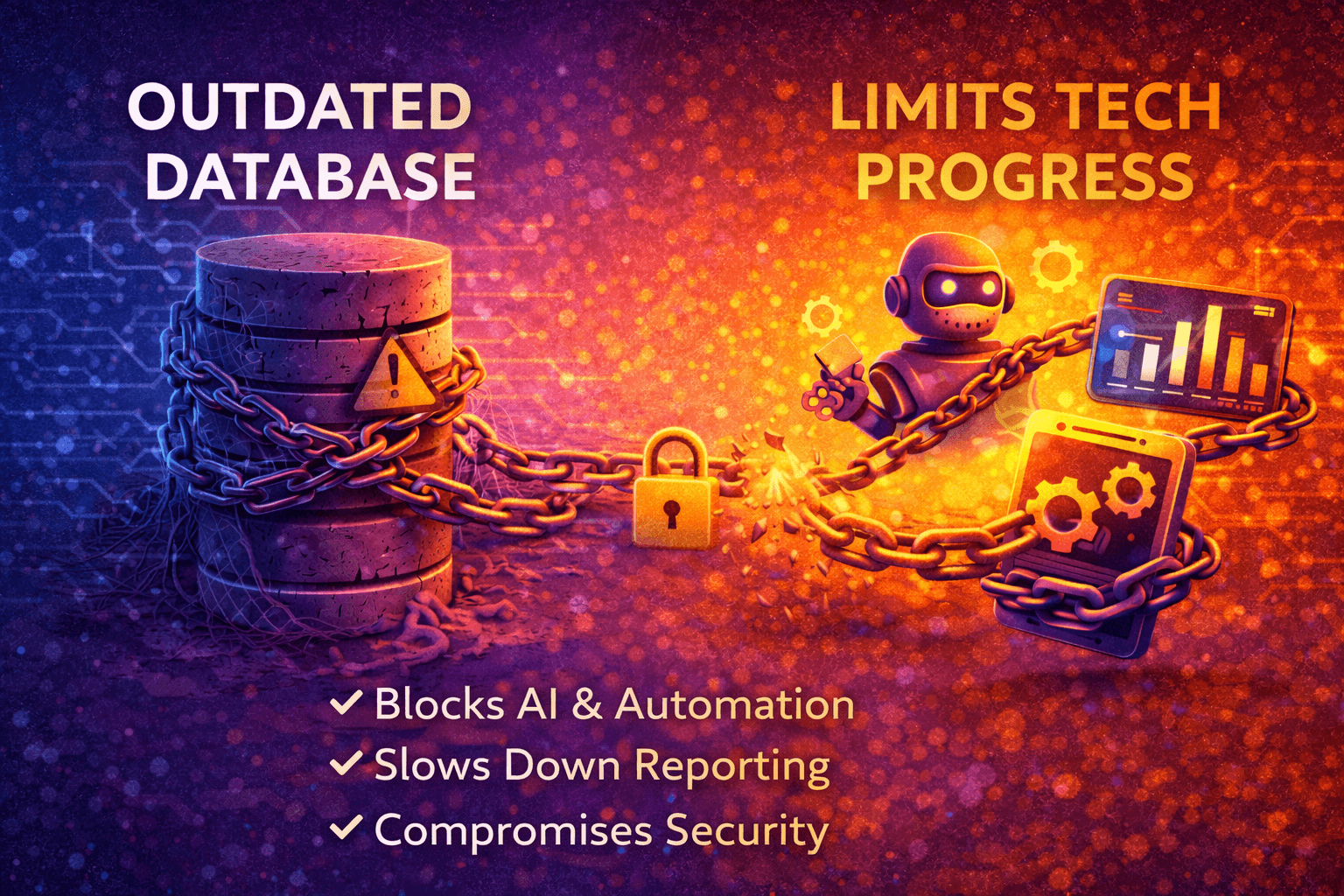
When companies talk about innovation, the conversation usually revolves around AI tools, automation platforms, and advanced dashboards. But very few leaders look beneath the surface. The truth is, the biggest barrier to intelligent systems is often not the software you buy — it’s the database design you’re still running from a decade ago.
Legacy database structures were created for stability, not intelligence. They were built when systems were transactional, reports were static, and integration requirements were minimal. Today, businesses expect real-time insights, predictive analytics, seamless workflows, and scalable automation. Unfortunately, outdated schemas were never meant to support that future.
Why Database Design Matters More Than You Think
AI, automation, and reporting all depend on the same foundation: clean, well-structured, and connected data. When your schema is rigid, overloaded, or inconsistent, every advanced capability becomes harder and more expensive to implement.
Here’s how old database designs quietly sabotage growth.
1. Legacy Schemas Kill Scalability
Older systems often rely on monolithic tables, hard-coded relationships, and overloaded fields that serve multiple purposes. As new requirements emerge, teams bolt on more columns, patches, and workarounds.
This creates:
- Slow queries that grow exponentially with data volume
- Complex joins that are hard to optimize
- High risk of breaking dependencies when changes are made
Instead of scaling smoothly, the system becomes fragile and unpredictable.
2. AI Struggles With Poor Data Models
AI doesn’t thrive on raw data. It thrives on meaningful relationships.
When customer records, transactions, products, and events aren’t clearly modeled, AI systems can’t detect patterns correctly. Models receive noisy, incomplete, or ambiguous inputs, resulting in:
- Inaccurate predictions
- Low confidence scores
- Biased or misleading insights
In many failed AI projects, the algorithm wasn’t the problem — the data architecture was.
3. Automation Becomes a Maintenance Nightmare
Automation depends on structured workflows and reliable triggers. But in legacy schemas, business logic is often buried inside stored procedures, undocumented scripts, or manual interventions.
That leads to:
- Automation flows that break silently
- High dependency on tribal knowledge
- Expensive fixes every time a process changes
Instead of accelerating the business, automation turns into a constant firefighting exercise.
4. Reporting Slows Decision-Making
Old schemas were designed for batch reporting — not real-time insight.
Data is scattered across tables with unclear ownership. Transformations are hard-coded. Teams spend more time reconciling numbers than interpreting them.
The result?
- Delayed dashboards
- Conflicting KPIs
- Loss of trust in reports
When leaders stop trusting their data, decisions slow down — and so does growth.
5. Security and Compliance Risks Multiply
Security models evolve. Regulations tighten. Yet many legacy databases still operate with flat permission structures, weak audit trails, and outdated access patterns.
This exposes businesses to:
- Unauthorized data access
- Compliance failures
- High-risk vulnerabilities that are hard to trace
Modern platforms expect security by design — not as an afterthought.
The Strategic Shift: From Storage to Intelligence
Modern organizations don’t treat databases as storage systems. They treat them as intelligence platforms.
That means:
- Clear domain-driven schemas
- Event-driven data flows
- Decoupled services with clean interfaces
- Built-in governance, lineage, and observability
Reimagining your data foundation isn’t a technical exercise. It’s a strategic investment in how fast your company can learn, adapt, and innovate.
Ready to Modernize Your Data Foundation?
At Floatinity, we help businesses refactor legacy data architectures into scalable, AI-ready platforms — without breaking mission-critical systems. Whether you’re planning automation, advanced analytics, or AI adoption, it starts with getting your data right.
Let’s explore how your current data design may be limiting your future — and how we can help unlock its full potential.