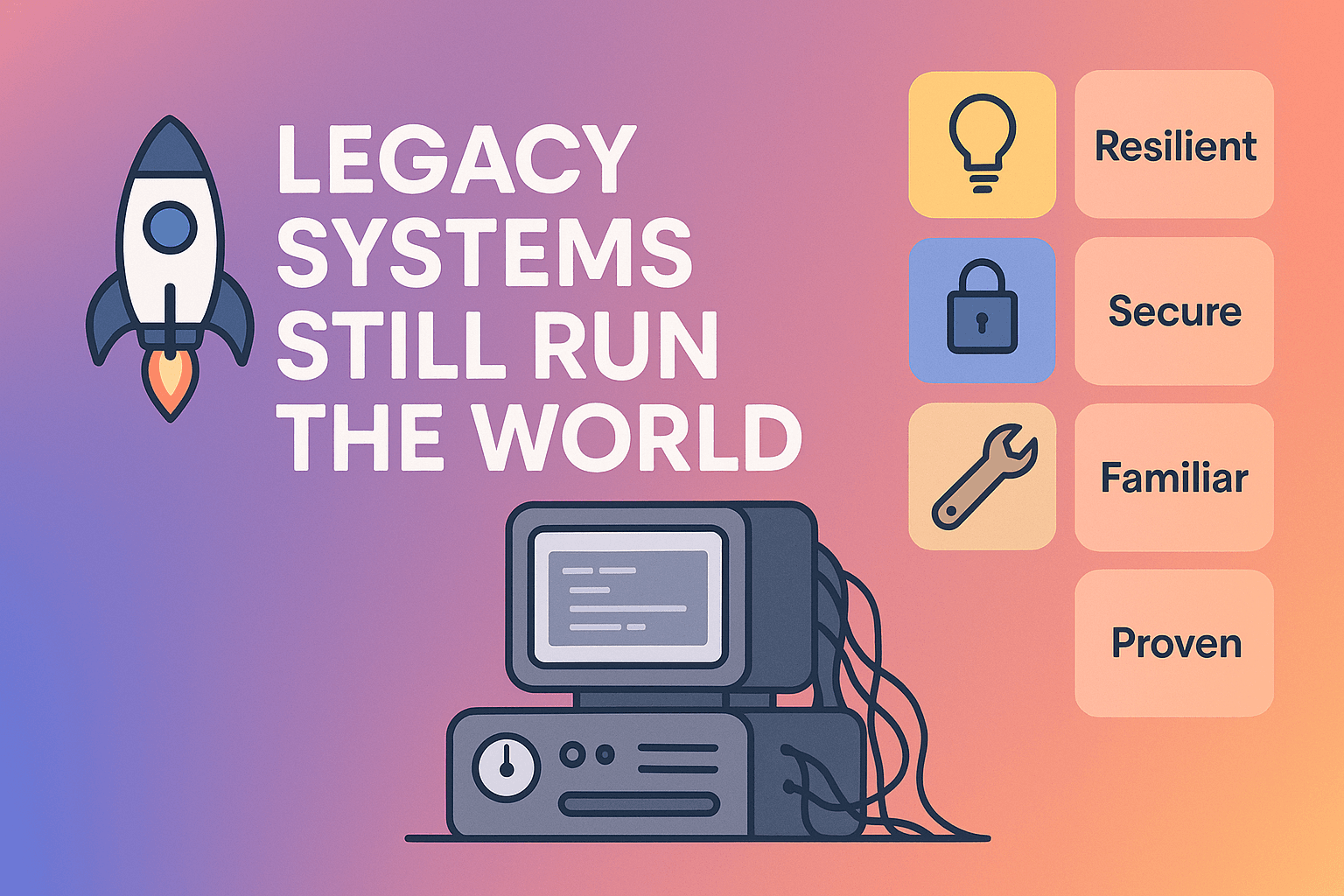
Legacy Systems Still Run the World : But That Doesn’t Mean Yours Should


In a world obsessed with “new,” it’s easy to forget that some of the most critical systems—banking, healthcare, air traffic control—are running on decades-old code. And you know what? They still work.
But here’s the big question: Just because legacy systems can run the world, does that mean they should be running yours?
Let’s dig in.
🧱 The Value Legacy Systems Still Deliver
Before we talk modernization, let’s give legacy systems their due. They’re not just old—they're often:
- Reliable — They’ve stood the test of time
- Understood — Teams know how they work, and that builds confidence
- Stable — Proven in production, bugs ironed out years ago
- Integrated — Connected deeply into the business flow
In short, these systems aren’t always problems to be solved. Sometimes, they’re assets to be preserved.
📈 Traits of a High-Value Legacy System
So how do you know if your legacy system is worth holding onto—for now?
Look for these traits:
💡 Resilient
Your legacy app is still standing while others come and go. That’s not luck—that’s architecture and consistency. If it’s not breaking under pressure, it might still have a place.
🔒 Secure
Security is earned over time. Legacy systems, when well-maintained, often have hardened protocols that have been tested repeatedly. No zero-day panic attacks here.
🛠️ Familiar
Familiarity means lower onboarding time. Teams that know the system inside out can troubleshoot faster and deliver without major delays.
⏳ Proven
Legacy systems are time-tested. The bugs have been found (and hopefully fixed), edge cases covered, and performance metrics established.
⚠️ But Here's the Catch...
Just because something still works doesn’t mean it still works for you. Technology is supposed to serve your business goals—not slow them down.
A few red flags that your legacy system might be holding you back:
- It limits scalability or new feature development
- Integration with modern tools is a nightmare
- It’s running on unsupported platforms or outdated hardware
- Talent is hard to find because the tech stack is obsolete
- Maintenance costs are creeping up, fast
If any of those hit too close to home, it’s time to think about intentional modernization.
🔁 Modernization ≠ Total Replacement
One of the biggest myths in digital transformation? That you have to scrap your legacy system entirely to move forward.
In reality, smart modernization is about evolution, not revolution.
Here’s how to start small but smart:
- Integrate new layers gradually using APIs and service wrappers
- Refactor bottlenecks, not the whole system
- Use AI-powered tools to understand, document, and clean up code
- Migrate critical components incrementally to the cloud
- Prioritize based on business value, not just tech trends
The goal? Keep what works. Update what doesn’t. That’s how you evolve without disruption.
🧭 Strategy First, Then Stack
The biggest mistake companies make is chasing trends before defining their needs.
Ask yourself:
- Is this legacy system aligned with our business strategy?
- Does it support the user experience we want to deliver?
- Is it cost-effective over the next 3–5 years?
- Are we making decisions out of fear (of falling behind) or clarity (on where we’re going)?
Your tech stack should always follow your strategy—not the other way around.
🔮 Embrace the Old, But Don’t Be Ruled by It
Legacy systems aren’t villains. They’re the unsung heroes of uptime, stability, and proven results. But clinging to them out of comfort or fear can lead to stagnation.
The smartest teams? They respect the past, but they don’t let it dictate the future.
You don’t have to burn everything down to innovate. You just have to modernize on purpose.