

When organizations decide to modernize their products, the first instinct is almost always visual. New dashboards. New colors. New layouts. It feels like progress. Stakeholders see change, users get something fresh, and leadership believes transformation is underway.
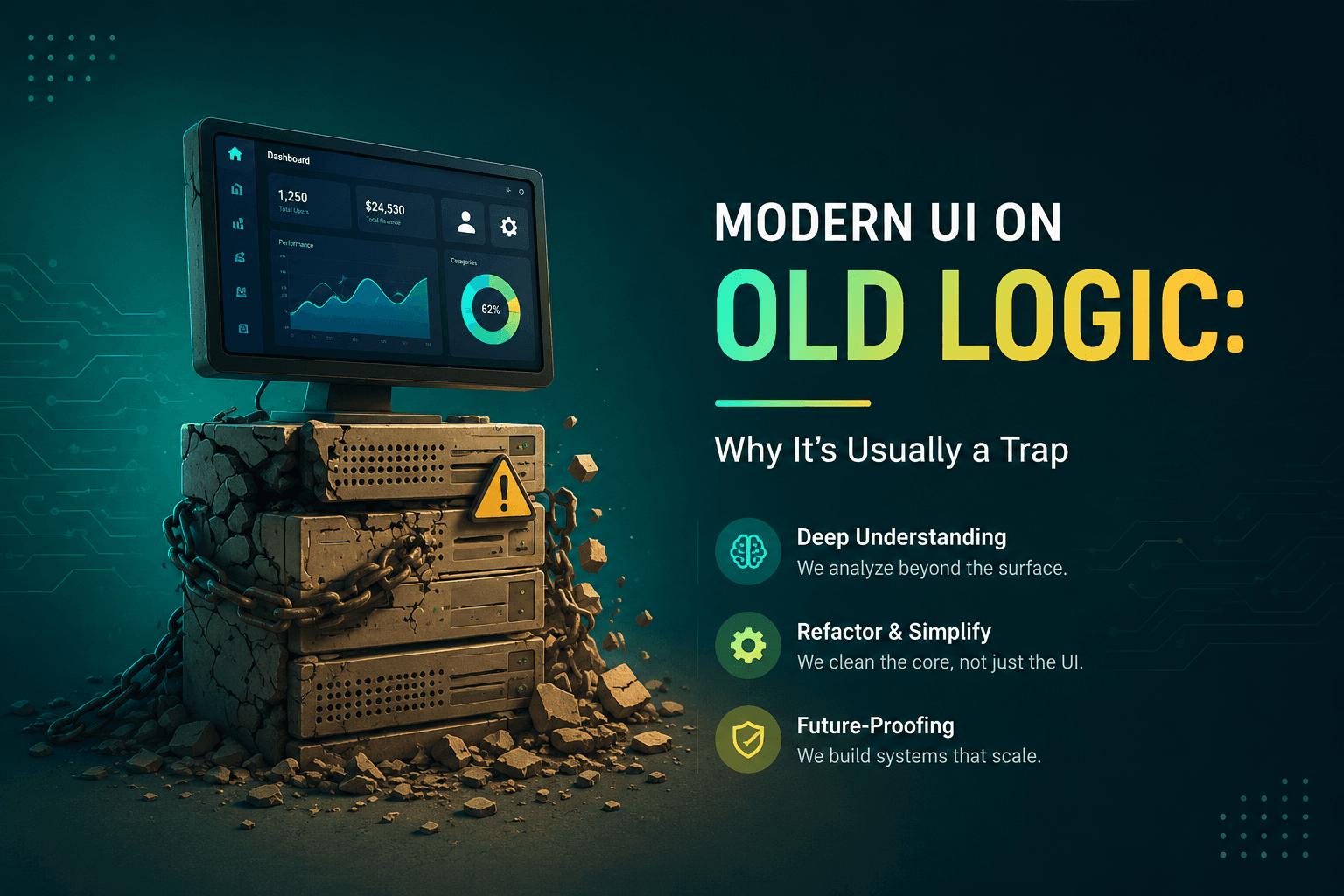
But in many cases, the shiny new interface is only a veneer over the same fragile, outdated core.
And that’s where modernization quietly turns into a trap.
The Illusion of Progress
A modern frontend can make any system look impressive. Animations are smooth, charts are interactive, and workflows appear simplified. Yet underneath, the same brittle business rules, hard-coded logic, and decade-old database structures still run the show.
The danger is perception.
Once a new UI is deployed, teams assume the system is “modernized.” Budgets move elsewhere. The urgency disappears. But operational pain remains — only now it’s harder to see because the interface hides it.
Why Old Logic Undermines New Design
Legacy business logic wasn’t built for today’s demands. It was written for lower transaction volumes, simpler rules, and fewer integrations. When wrapped with a modern frontend, these limitations surface in new ways:
- Complex logic buried deep in the backend becomes harder to change
- Performance bottlenecks remain, now amplified by richer interfaces
- Workflows break under real user load
- Automation and analytics projects stall because the core logic is too rigid
The UI is modern. The experience is not.
Deep Understanding Comes Before Design
Successful modernization starts with understanding what actually runs the business.
This means mapping:
- Where business rules live
- Which modules own critical decisions
- How data flows between components
- What parts of the system people fear touching
Without this clarity, UI redesigns become cosmetic exercises rather than transformational ones.
Refactor, Don’t Just Replace
Replacing screens without re-engineering logic is like repainting a building with cracked foundations.
True modernization involves:
- Simplifying tangled workflows
- Removing duplicated or dead logic
- Making business rules explicit and testable
- Decoupling systems so they can evolve independently
This is not glamorous work — but it is the only kind that delivers lasting value.
Design for Adaptability, Not Perfection
Many teams aim to build the “final” system during modernization. That mindset creates paralysis.
Instead, focus on adaptability.
Ask:
- Can this logic support new features without rework?
- Can it integrate easily with future tools?
- Can teams understand and change it safely?
A future-proof system is not one that is complete — it is one that is flexible.
Test What You Can’t See
Hidden bugs are the most expensive ones.
Whenever legacy logic is exposed through new interfaces, rigorous testing becomes non-negotiable:
- Validate edge cases
- Simulate real-world loads
- Monitor failures that users may never report
Modern UI magnifies backend weaknesses. Testing is your only early warning system.
Collaboration Is the Missing Ingredient
Frontend teams see usability. Backend teams see feasibility. When these worlds don’t intersect early, modernization fragments.
Involve both sides from day one. Let design decisions be informed by logic realities, and let architecture evolve alongside user experience.
That’s how modern systems are built — not layered.
The Foundation Matters More Than the Facade
A beautiful interface cannot compensate for flawed fundamentals. It may buy time. It may impress stakeholders. But it will not protect you from the cost of change later.
Modernization isn’t about how the system looks.
It’s about how safely, quickly, and confidently it can evolve.
Ready to Modernize the Right Way?
At Floatinity, we help teams modernize both experience and core logic — ensuring your platform isn’t just visually updated, but structurally future-ready.
Let’s explore how your system can move beyond surface-level change.